Glorifying Phylogeny
My work Glorifying Phylogeny started with admiration for the drawings of German zoologist Ernst Haeckel in his book “Art Forms in Nature.” In this book he illustrated hundreds of organisms, many of which were documented for the first time.
The visual language of Haeckel’s illustrations left a strong impression on me. Romanticizing these minuscule beings inspires me. I recognized familiar shapes from everyday life in many of these illustrations. It made me realize that the mind associates unfamiliar things with the familiar to find answers. I find this concept exciting, and I decided to incorporate it into my own interpretation and to study Haeckels research.
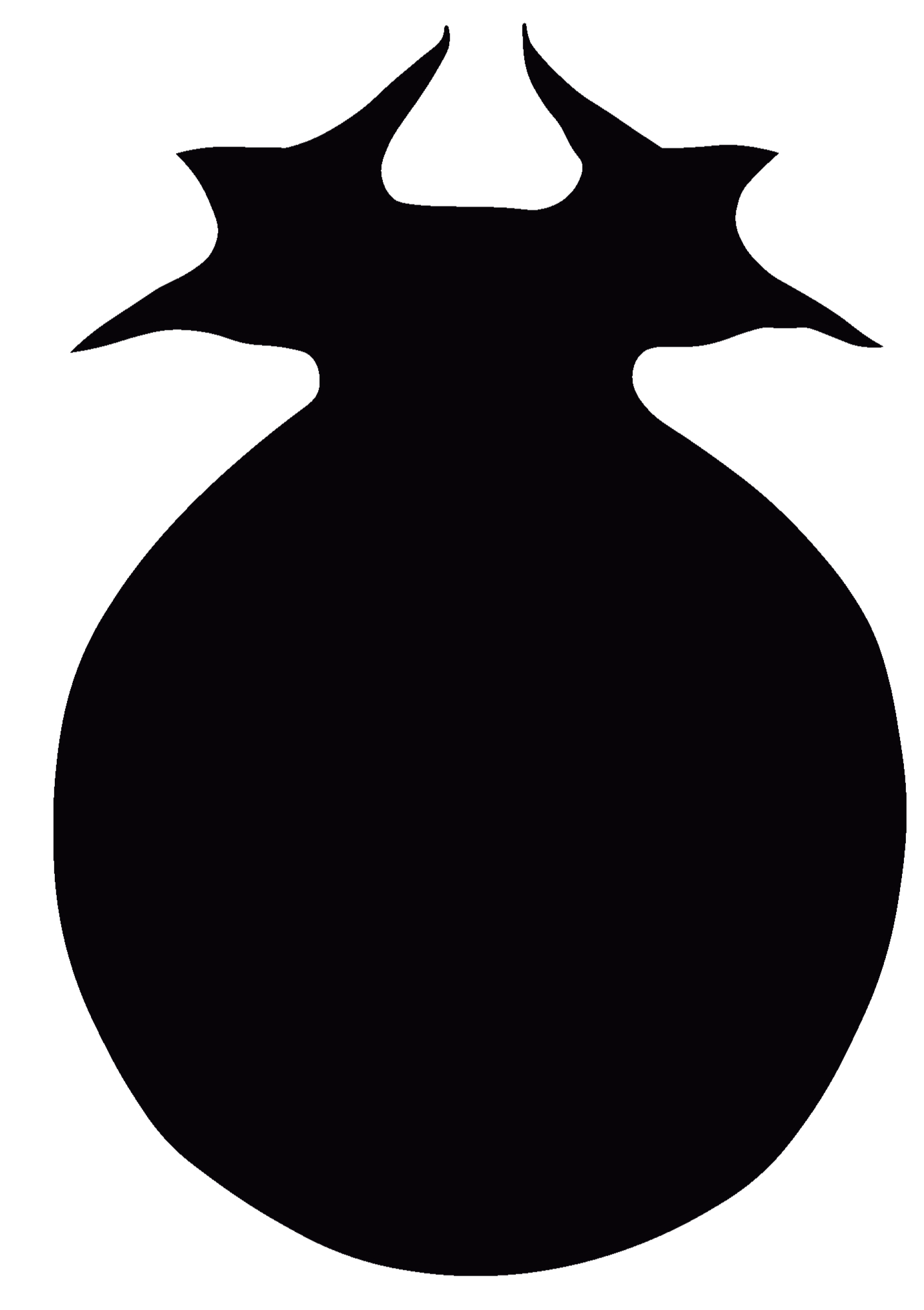
In his work he frequently discusses phylogeny: the study of evolutionary relationships and the history of descent of organisms. It describes how one group of organisms has evolved from another group. I found this to be a fascinating phenomenon and decided to apply it myself. I chose five plankton species and used them as puzzle pieces. Each curvature or spike in my work can be traced back to one of those five organisms.
Glorifying Phylogeny is an ever-evolving series of objects created from these five plankton species.
1. Stichophaena Ritteriana
The shell is pear-shaped and twice as long as it is wide. The upper half is slender and conical, consisting of seven segments of almost equal length that gradually increase in width. Above these is a conical horn of the same length. The lower half is formed solely by the eighth segment, which is very large, inflated, and as long as the seven other segments combined. The pores are small, numerous, and circular. This species is dedicated to Haeckel’s esteemed friend, Dr. Paul von Ritter.
2. Calocyclas Monumentum
The shell is almost conical, with two very deep constrictions. It is entirely covered with long, diverging spines, approximately as long as the thorax*. The head is nearly spherical, with a very large, three-sided pyramidal horn. The pores are irregular and roughly circular. In the smaller thorax, the pores are oall diverent kind of sizes, while in the larger thorax there are three to four transverse rows of larger pores separated by numerous much smaller pores. The peristome** is widely open, with a crown of twelve large, triangular, vertical feet. These feet are almost as long as the thorax. At the base of each foot there is a large, round, triangular pore.
* The rib cage / abdomen
** The rim of a mouth opening
Both of these organisms belong to the group Radiolaria. This is a group of protists consisting of very small, unicellular organisms. They are found in all seas.
Radiolaria occur in numerous species and forms, with sizes ranging from 0.03 to 2 mm. To observe Radiolaria properly, a good microscope is required. They are notable for the intricate structure of their siliceous skeleton. The shape of the skeleton can vary enormously. The simplest forms resemble a spherical mesh through which spines protrude. More complex species display elegant, regular, and intricate geometric forms.
3. Challongoria Murrayi
Phaeodaria are traditionally considered as radiolarians, but in molecular phylogenetic trees they appear to have no close relationship to the other groups. They are distinguished by the structure of their central capsule and by the presence of a phaeodium, an buildup of waste particles within the cell. Phaeodaria produce hollow skeletons composed of amorphous silicon dioxide (a substance that is virtually insoluble in water) and organic material, which rarely fossilize. In contrast to true radiolarians, there are no cross-bridges between the spines.
4. Dinophysis Sphaerica
Dinoflagellates are usually considered algae. Dinoflagellates are plankton that occur in both fresh and salt water. Their populations vary with the temperature of the sea surface, salinity, and depth. In terms of number of species, dinoflagellates are one of the largest groups of marine eukaryotes. Some species use the bodies of animals as hosts and play an important role in the biology of coral reefs.
5. Peridinium Divergens
This organism behaves in some ways like a plant and in other ways like an animal. It behaves like a plant because it contains chloroplasts, wich allow it to use sunlight to make sugars from carbon dioxide and water. Because of this its often classified as part of the phytoplankton class. And like a animal because it can swim using two flagella (a kind of wip) and it can actively move toward light.
It can have a diameter of thirty to seventy micrometers. and it also belongs to the protist group Dinoflagellates.